
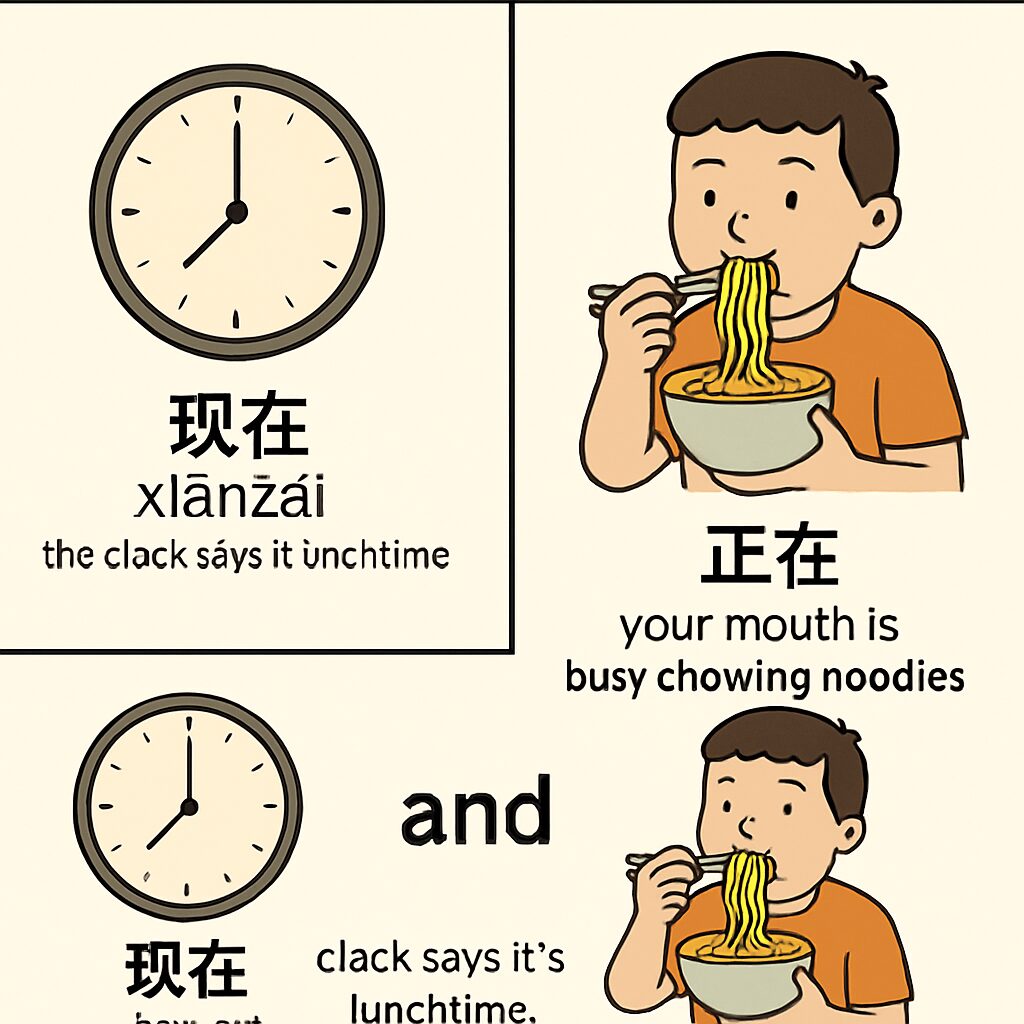

Clarifications on how “正在[zhèngzài] + Verb(action)” can correspond to past, present, and future progressive in English.
1. Present Progressive (现在进行时) – Happening Now(at this moment)
Structure:
✅ Sub + 正在[zhèngzài] + Verb (+ 呢ne) → “is/are doing (at this moment )”
Examples:
– 妈妈正在做饭。(Māma zhèngzài zuòfàn.)
→ Mom is cooking (at this moment.)
– 他们正在开会呢。(Tāmen zhèngzài kāihuì ne.)
→ “They are in a meeting (at this moment).”
– 外面正在下雨。(Wàimiàn zhèngzàixiàyǔ.)
→ “It’s raining outside (at this moment).”
Key Point:
– If no time word is given, “正在” defaults to present progressive.
– Adding “呢” makes it sound more natural in spoken Chinese.
—
2. Past Progressive (过去进行时) – Was/Were Doing
Structure:
✅ Sub+Time (过去) + 正在 + Verb → “was/were doing (at that time)”
Examples:
– 昨天下午五点,我正在健身。(Zuótiān xiàwǔ wǔ diǎn, wǒ zhèngzài jiànshēn.)
→ “Yesterday at 5 PM, I was working out.”
– 你打电话的时候,我正在洗澡。(Nǐ dǎ diànhuà de shíhou, wǒ zhèngzài xǐzǎo.)
→”When you called, I was taking a shower.”
– 去年的这个时候,我们正在旅行。(Qùniánde zhège shíhou, wǒmen zhèngzài lǚxíng.)
→ “This time last year, we were traveling.”
Key Point:
– The past time marker (e.g., 昨天[zuótiān], 那个时候) makes it past progressive.
—
3. Future Progressive (将来进行时) – Will Be Doing
Structure:
✅ Time (未来) + 正在 + Verb → “will be doing (at that time)”
Examples:
– 明天这个时候,他(可能)正在坐飞机去北京。(Míngtiān zhège shíhou, tā (kě néng) zhèngzài zuò fēijī qù Běijīng.)
→ “This time tomorrow, he will be flying to Beijing.”
– 下周日晚上八点,我们(会)正在看电影。(Xià zhōurì wǎnshang bā diǎn, wǒmen (huì) zhèngzài kàn diànyǐng.)
→ “Next Sunday at 8 PM, we will be watching a movie.”
– 十年后,她(可能)正在经营自己的公司。(Shí nián hòu, tā kě né n gzhèngzài jīngyíng zìjǐ de gōngsī.)
→ “Ten years from now, she will be running her own company.”
Key Point:
– The future time marker (e.g., 明天, 下个月) makes it future progressive.
4. Special Cases & Clarifications
(1) Can “正在” Be Used Without a Time Word?
– Yes, but it defaults to present progressive (happening now).
– 他们正在聊天。(Tāmen zhèngzài liáotiān.) → “They are chatting.”
(2) Can “正在 + verb ” Be Used for Habits or General Truths?
– No! It only describes ongoing actions at a specific time.
– ❌ 我正在喜欢喝茶。(Wrong! “Like” is a state, not an action.)
– ✅ 我正在喝茶。(Correct! “Drinking tea” is an action.)
(3) Difference Between “在+verb ” and “正在+ verb”
– “在 + Verb”= General ongoing action.
– “正在 + Verb” = Stronger emphasis on “right at this moment.”
– 我在学习。(Wǒ zài xuéxí.) → “I’m studying.”
– 我正在学习。(Wǒ zhèngzài xuéxí.) →”I’m studying (at this moment). (stronger)
Summary Table
| Time Reference | Chinese Example | English Equivalent |
|—————|—————-|——————-|
| Present (现在) | 他正在跑步。 | “He is running.”|
| Past (过去) | 昨晚九点,他正在跑步。 | “Last night at 9, he was running.” |
| Future (未来) | 明天这个时候,他正在跑步。 | “This time tomorrow, he will be running.” |
Final Tips:
1. “正在+ verb(action )” = Action in progress(no tense on its own).
2. Time words decide past/present/future.
3. Avoid using “正在” for non-actions (e.g., 喜欢, 知道).